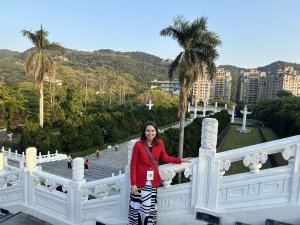
The first year of my Fulbright in Taiwan has made me extremely grateful that I will have a second. Already, I feel that I’ve learned and grown immensely—but if I had to leave Taiwan now, I would certainly think it too soon. The luxury of knowing that I will have a long period of time here has been the background motivator to throw myself into academic engagement, language learning, and relationship-building. A lot of my first year in Taipei has been spent on just this—getting to know new people and places, improving my language skills, finding community, and learning to best navigate my host institution, National Chengchi University (NCCU). With this first year complete, I take this opportunity to reflect on a few of the most memorable experiences of my Fulbright (Part I).
One of the most valuable parts of my first year in Taiwan was the opportunity to participate in the Critical Language Enhancement Award (CLEA) program run by FSE Taiwan. The program pairs Fulbright students with one-on-one teachers, offering the flexibility to tailor 10 weekly hours of language learning to suit individual academic interests and language needs. This program not only greatly improved my Chinese language ability, but also offered the chance to engage in project-based learning examining a series of issues in Taiwan’s society. In partnership with my Chinese teacher, I was able to use a mix of classic language instruction textbooks and real-life materials to deep-dive into a number of issues:
- Our first project-based learning module explored the issue of disinformation in Taiwan, and more specifically, how Taiwan’s civil society has rallied to combat the spread of fake news. This project also complemented research I was working on with another IMAS classmate for an NCCU course. For the project, we interviewed two editors at Taiwanese Factcheck centers, Taiwan Factcheck Center and MyGoPen, using the opportunity both to learn more about these individuals’ work, as well as to practice speaking and listening skills in a real-world application. For coursework, my teacher and I read the book《破擊假新聞:解析數位時代的媒體與資訊操控》[Beating Fake News: Media and Information Manipulation in the Digital Age] , a monograph by NCCU Journalism department professors, designing language learning classes around content, vocabulary, and grammar patterns encountered in the text.
- Our second project-based learning module focused on understanding the development of Taiwan’s semiconductor industry—which is today a source of national pride for its story of rapid development and irreplaceable status in global supply chains. After class time dedicated to reading articles about the history and current status of the industry, we took two field trips out of Taipei to see the sites of innovation itself. First, of course, was a trip to Hsinchu, the poster child of Taiwan’s semiconductor industry and home to the headquarters of Taiwan Semiconductor Manufacturing Company (TSMC). Along with touring TSMC’s museum of innovation, we had the opportunity to meet a semiconductor engineer and hear a more informal view on the life of workers in this high stress environment. Later in the semester, we traveled even further from Taipei to visit the Taiwan Semiconductor Research Institute (TSRI) in Tainan, where local staff gave us a tour of the research labs and cutting-edge technologies used in semiconductor design. While visiting TSMC had offered insight into Taiwan’s semiconductor industry through a corporate lens, TRSI expanded our understanding of how the Taiwan government partners with private enterprise to support Taiwan’s innovation ecosystem.
- Finally, our last project explored the topic of migrant workers in Taiwan. Since the 1980s, Taiwan has relied on employing a large population of migrant workers from Southeast Asia (primarily Indonesia, Vietnam, Thailand, and the Philippines). As Taiwan’s economy has continued to develop with an aging society and low birthrate, demand for migrant workers has persisted and grown—however, Taiwan offers very few pathways for immigration and most migrant workers rely on a system of migration agencies for their passage to and life in Taiwan. I grew more interested in this topic after watching two documentaries at the 2024 Taipei International Documentary Festival (TIDF): Garden《公園》and Miles to go before I Sleep《九槍》, both of which explore different elements of Southeast Asian migrant workers’ lives in Taiwan. To expand on the topic, my teacher and I read excerpts of the book《移工築起的地下社會:跨國勞動在臺灣》 [Underground Lives: Stories Untold for Migrant Workers in Taiwan], and interviewed the author Chien Yung-ta—who himself was a Fulbright scholar to the United States. This project was extremely insightful into a part of Taiwan society that rarely features in international conversations about Taiwan and has greatly impacted my views on Taiwan’s society and democratic future.
Given that CLEA is only available during the first year of a Fulbright master’s program, I am sure to greatly miss my time with my teacher and the many opportunities afforded by the program as I head into my second year. What will continue is my coursework at NCCU. Over that past year, I’ve completed about two-thirds of my master’s coursework. My master’s program, called the International Master’s in Asia-Pacific Studies (IMAS), is largely flexible, including a wide array of possible course offerings and the option to take classes across other departments. In my first year, I aimed for diversity in my courses, hoping to move beyond my prior work focus on China. I learned about democratization across East and South Asia, took two seminars on regional security studies, researched Japan’s evolving foreign policy stance, and expanded my understanding of Southeast Asian politics.
More than anything else, I learned about Taiwan’s history, politics, foreign relations, security situation, and much more through my classes and life here. Although prior to coming to Taiwan, I had researched cross-Strait relations and Taiwan’s position in the international system, I had no idea how little I really understood about Taiwan until living here. In particular, I’ve been struck by learning about Taiwan’s democratization and reckoning with authoritarian history. Over the winter, experiencing two events greatly impacted my understanding of Taiwan. The first was the presidential election, an event in the background of my first months in Taiwan in the form of ubiquitous campaign posters, events, and as the day drew nearer, massive rallies unlike any I’d seen in the United States. The day itself was characterized by orderliness: I witnessed the public counting of votes at a nearby elementary school, as anyone in Taiwan is welcomed to do, and later in the night watched as losing candidates offered prompt concession speeches. Over a month later, I reckoned with the significance of how far Taiwan has come in terms of democratization as I observed the February 28 (228) Memorial Day, a day of national remembrance of the mass violence kicked off in February 1947 to suppress any hints of possible dissent to the then-new rule of the KMT in Taiwan. How to reckon with transitional justice and safeguard against the threat of authoritarian rule remain questions that hang many of the conversations I’ve have in the past year, remaining live issues impacting national politics.
While I spent most of my first year diversifying my academic pursuits and working to better understand the Taiwan society I am now living in, I have begun circling back to my prior focus on China as I prepare for my thesis. My favorite course that I took last year was not from my own program, but a Chinese-taught class from the Department of East Asian Studies that focused on analyzing societal change in China. While initially extremely challenging due to language of instruction, this class proved to be the most rewarding of my academic time at NCCU. The shift from learning Chinese to learning in Chinese (though of course language learning will never end) has been extremely rewarding and opened a lot of new spaces for academic engagement. The class featured a mix of English-language international scholarship with Chinese-language scholarship from Taiwan as well as scholarship from China. Discussing the different academic perspectives produced across this scholarship with classmates from Taiwan, exchange students from China, and other foreign students from Korea, the United States, and Singapore produced some fascinating conversations, certainly of the type I could not hope to have in a graduate school class in the United States. Learning more about the China Studies field in Taiwan has also planted the seeds for my thesis, with which I hope to further explore the development of this academic field in Taiwan and its intersection with the trend of growing numbers of international scholars and students coming to Taiwan as an alternative to study in China.
I now look forward to moving on to part two of my Fulbright journey, which will be filled by more research and writing, rather than the reading and listening that has characterized of my first year. In the coming year, I look forward to continuing language learning, classwork, and deepening my understanding of Taiwan society and politics. More than that, I look forward to building out my thesis research, and contributing in turn to the host institution and academic community have welcomed me to Taiwan.