Reflecting on my Fulbright experience as a senior teaching scholar in Taiwan I feel a deep sense of gratitude. I am grateful for the opportunity to advance and contribute meaningfully to my professional mission. Additionally, I am grateful for the immersive experience to gain a deeper connection with my heritage and culture.
My career goal is to advance nursing as a profession and expand access to quality healthcare. The Fulbright project at Chang Gung University of Science and Technology (CGUST) is titled, “Strengthening Nurse Practitioner Education, Advancing Health for All”. This project was born out of the belief that strong nurse practitioner (NP) education is essential to improve health outcomes. My project included teaching, mentoring, consulting, and public presentations.
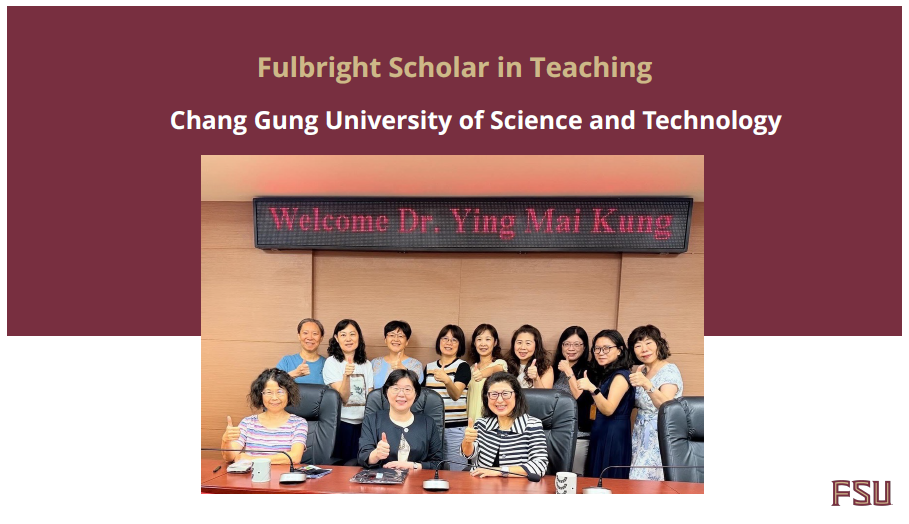
Teaching
I taught an Advanced Health Assessment and Clinical Reasoning course to master’s-level nursing students focusing on essential knowledge of how to conduct a physical exam. These sessions especially highlighted the value of thinking critically, and to adopt a systematic clinical reasoning process. This clinical reasoning pathway enables learners to articulate their reasoning process and be more effective and accurate in reaching a diagnosis. Through case discussions, problem representation, and reflection, students examined how intuition, analysis, prior experience, and bias influence clinical decisions. Witnessing students grow more confident as their reasoning became intentional and organized was one of the most fulfilling aspects of my teaching.
I also had the privilege of guest lecturing in both undergraduate and graduate programs about U.S. systems and clinical topics. Talks about U.S. APRN education, scope of practice, and pathways of becoming a nurse and nurse practitioner, sparked rich conversations about similarities, differences, and shared challenges across healthcare systems. One lecture focused on mental health assessment, specifically on how we can recognize and de-stigmatize sadness, depression, and emotional distress in culturally responsive ways. The openness and honesty of those discussions reinforced just how universal and human these experiences are.

Faculty Mentorship
The second area of this project was mentorship of faculty. The mentorship at the CGUST extended beyond individual consultations to broader group discussions about teaching philosophy, learner engagement, and curriculum design. These sessions fostered faculty’s capacity to be more aware of their metacognitive teaching and learning processes. Additionally, these sessions focused on learner-centered teaching strategies and supported faculty in adapting evidence-based educational strategies to their own cultural and institutional contexts while maintaining alignment with professional standards. The overarching goal is for students to become more self-motivated and self-reliant, life-long learners.
Consultation and Policy Advocacy
As part of the consultative role, I collaborated with institutional leaders and administrators on curricular design, implementation, evaluation, and revision processes. This work focused on aligning NP education with evolving professional standards and workforce needs while ensuring academic rigor and clinical relevance.
One challenging issue Taiwan and the U.S. both face is a significant shortage of nursing faculty. However, unlike in the U.S., no full-time clinical or teaching track positions currently exist in academia. Taiwan’s full-time academic faculty roles are typically tenure track, with a strong emphasis on research productivity and securing grant funding. Advancement and promotion of tenure track faculty are contingent upon demonstrated success in research and funded projects rather than teaching excellence or clinical experience. This structure presents a substantial challenge for NP faculty who may find it difficult to sustain a robust research portfolio while fully dedicating themselves to teaching and maintaining their clinical expertise in practice. Additionally, this policy may hinder qualified and experienced clinical NPs from seeking employment in academia.
I collaborated with the Ministry of Health and Welfare (MOHW) and addressed strategic initiatives to strengthen the NP education. Two key initiatives emerged from these consultations. The first was the development of a nurse practitioner educator certification program. This initiative aimed to formalize preparation and recognition of NP educators, reinforcing teaching excellence and instructional competence within academic settings. The second initiative focused on advocating for the creation of a clinical faculty track within academia. Establishing a clinical faculty line can afford faculty to focus on teaching excellence. This policy will attract and retain experienced nurse practitioner faculty in academia and will enhance student learning.

Public Lectures and Professional Seminars
Public lectures and seminars extended the reach of the project beyond one institution. I was invited to speak at the National Taiwan University College of Nursing, National Taipei University of Nursing and Health Sciences, National Yang Ming Chiao Tung University College of Nursing, and the National Taiwan University Cancer Center. We covered topics such as nursing leadership in policy and politics, nursing career pathways, and various clinical topics. I was amazed at the mix and the diversity of the graduate students who came from many southeastern Asian countries and from countries in Africa. The richness of the students’ perspectives stimulated broader conversations about the nursing professional identity, the need for policy advocacy, and impact on health and health care. Furthermore, these policy-oriented discussions underscored the interconnectedness of education, regulation, and workforce sustainability. By engaging at both the curricular and system levels, the Fulbright project contributed to conversations that extend beyond a single institution to national nursing education infrastructure.
These speaking engagements also fostered networking opportunities with nursing and medical communities. As a result, I was invited on tours of premier hospitals and medical centers. I was able to gain an in depth understanding of the health care systems in Taiwan as well as have discussions regarding future collaboration opportunities.


Culture, Heritage, and Community Engagement
I was born in Taiwan and moved to the United States many years ago. Through this project I was able to immerse myself in improving my language skills and reconnecting with various customs and cultures in Taiwan. What struck me most was the kindness of the people. They were considerate, helpful, polite, warm, and genuinely welcoming. Even strangers readily offered assistance and thoughtful, caring advice. I was welcomed into their community, invited to events, and shared meals together.
One memorable experience was attending an annual Special Olympics competition in Miaoli City. The organization’s mission is to inspire courage, hope, and confidence. These athletes committed to a year-long program that incorporated physical exercise into a routine such as dance, drumming, or drama. These programs emphasized values like inclusion, dignity, and compassion toward individuals with intellectual disabilities, people who are often overlooked or marginalized. I also joined my residential community’s line dancing group. We practiced twice a week, learned routines, and performed at three community Christmas talent shows. My experience with the line dancing group deepened my appreciation for the Special Olympics participants. I truly admired these athletes’ dedication to mastering competition routines despite intellectual challenges, and I deeply admire their bravery in performing before large audiences. It was priceless to see the confidence and exhilaration demonstrated through their performances, a product of a year-long dedicated effort.

The government’s investment in shaping Taiwan is evident. The National health insurance is affordable and available for all. Health care is easily accessible at a low cost. For example, the co-pay for six sessions of physical therapy costs around ten U.S. dollars. While loneliness is an epidemic in the U.S., the Taiwan government supports and subsidizes activities and clubs that foster social connectedness and combat loneliness. People are friendly. Strangers converse with one another as if they are long time acquaintances. Public transportation is clean, convenient, efficient, and affordable. I depended on it as my primary mean of transportation. Most of all, I felt safe in Taiwan. I took public transits and walked home alone even late at night.
Conclusion
My philosophy is summed up by the term “EMPLIFY”. That is my commitment to educate, motivate, empower with empathy to amplify… I set out to “EMPLIFY” nursing education in Taiwan. Indeed, I shared my expertise in teaching, sought to build faculty capacity, enhanced critical thinking and clinical reasoning education, and supported the development of sustainable academic and professional infrastructures for advanced practice nurses.
At the end of my Fulbright Taiwan experience, I am humbled. I have learned so much and I have been “EMPLIFIED” by this experience. My amazing students motivated me to dig deeper in developing teaching material that is geared to their culture and their needs. They amplified my teaching by applying the critical thinking and clinical reasoning and assessment skills on their patients and sharing with others. Faculty mentorship empowered me to be bolder, advocating for policy initiatives that aimed to recruit and retain experienced academic faculty in Taiwan and to strengthen the quality of NP education. The networking and collaboration enhanced our teaching and research trajectory. Last, but not least, the Fulbright project fostered enduring relationships and friendships that are grounded in mutual respect and shared commitment. These relationships lay the foundation for continued collaboration, knowledge exchange, and global engagement beyond the formal Fulbright period.