The end of my Fulbright experience at National Tsing Hua University marks my 24th time in Taiwan. It is the third time that I have had a study abroad experience here and the first time completing a degree abroad. Being half-Taiwanese and having study abroad connections, I thought that I would understand how best to navigate earning a master’s degree in a different country. Arguably, I was not expecting the number of difficulties I encountered. Obtaining a master’s degree here has given me infinite amount of respect for international students who uproot their entire lives to obtain their own graduate degrees in the United States—sometimes in their second or third language. It is hard to cram two years of living into an 1,500-word essay while acknowledging the hardships and the enjoyment that came out of this.
Taiwan, to me, will always be a place I love. My memories are built here—fond recollections of watermelon juice and hot, muggy days. It is full of caramel candies tucked in the corner of my grandpa’s writing desk and the way my grandma keeps trying to feed me food. Southern Taiwan is my home. It is a part of me. And I think that the expectation of having Taiwan cradle me this time like it did all others ultimately made me a little disappointed. In this way, Hsinchu has made me adapt and made me be appreciative of what a privilege it is to be able to adapt, though it also made me intensely aware of all the other systemic things for which I needed support.
Notably, this ties very directly to Taiwan’s accessibility, and in particular, Hsinchu and NTHU’s accessibility. Because NTHU is a fairly large campus located on a hill without any direct route to the dormitories, I was often lacking in food access depending on my mobility for the day. As an intense stressor, trying to find accommodations for that became a challenge, as was finding my way to my classes from the dormitory. The friends that I made along the way reminded me how important community can be when navigating the world as a disabled person. It does not, however, negate the fact that society as a whole—whether it be in the United States or Taiwan—is often reacting to the lack of accessibility rather than attacking it head-on. A class I took at NTHU—environmental anthropology—asks how environment impacts humans. Perhaps a more in-depth explanation of what I am aiming at saying here is thus: what does it look like when we shape our environment and our environment shapes us? Tim Ingold, a prominent environmental anthropologist, sheds light on one way we do this—through dwelling. Dwelling, as defined by Ingold (2021), “situates [a person] amongst a world of materials” (p. 17) through which they bring about different objects they are attempting to make. It differs from building, such that building requires us to construct a world and then place living inside it, rather than engaging in an interplay between our environment and ourselves. A reminder—our environment shapes us and we shape our environment.
Hsinchu shaped me in the way that diamonds form from coal. That is, under intense pressure. I return to the fact above in stating that I have the upmost respect for international students having now been one myself. It’s a different type of hardship—navigating and planning to do things when your typical support systems are not there. Arguably, I contend they could be a lot better. They should be better. In saying that, I realize that it is part of everyone’s job to make that happen and something I tried implementing over my time here in Taiwan. I wanted to make my own community and make it better for the next year’s graduates (although my program has since been canceled). I compiled an arrival packet that somehow made its way to another Fulbright program at NTHU, which I’m hoping will be modified in order to continue to support both Fulbright and non-Fulbright students. I have carried my little group of Austronesian Studies students as a semi-admin, helping them sort out various problems and aided them in cross-cultural communication. I will also continue to write guidelines for how best to navigate thesis and graduation procedures.
I view this as a type of affordance, tying into the question about environment above. The time I have spent here and the resources and I have tried to build here is my attempt at dwelling in Hsinchu. Affordances were first defined by James Gibson (1979) as defining what a specific environment offers the animal. Dokumaci (2019) takes this definition further, such that “people can enable the emergence of, or directly become, affordances for another”. The activist affordances that I have had to make—those “micro, ephemeral, and performative acts/arts of worldmaking with which disabled people must literally make up and at the same time make up for, whatever affordances fail to readily materialize in their environments” (Dokumaci, 2023, p. 104) are things that I have focused on in order to bolster my experience here and make it better for other people too. In doing so, I have found that I like engaging in and understanding how to build community. It is perhaps this aspect that I want to pursue as I return back to the United States, especially in the arena of disability studies.
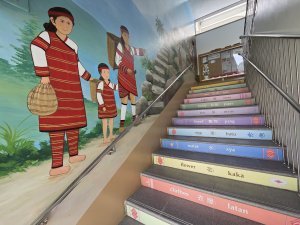
As a disabled person, I was consistently navigating broken accessibility features and an inaccessible campus. This often extended to the outside world around me—Taiwan oftentimes did not have sidewalks or accessible pathways where I wasn’t at risk of tripping or sharing the road with other motorcycles and vehicles. But on the other hand, Taiwan has consistently given me affordances that I have not been able to find in Utah, such as low-barrier access to museums and exhibitions. It allowed me to have deeper connections with my family and understand the intricate history that comes from its colonial history and the ways that it is still striving to improve today, especially with regard to its transformative and historical justice towards Indigenous peoples. I am immensely grateful to have had the opportunity to learn more about Austronesian studies, to be able to travel to Indigenous experimental schools and other villages like Smangus, as well as access to other worldviews. Taiwan has allowed me to tentatively pursue my own path in trying to connect with my heritage language of Taiwanese Hokkien.
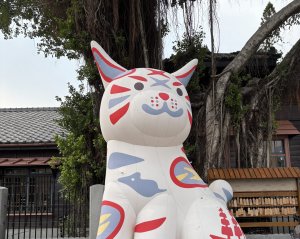
These are all things that I will take with me. And in an effort to extend an affordance to those who are hesitant to come to Taiwan, who aren’t sure where to go or what Taiwan has to offer—here are my favorites places that I have seen. Taiwan is a beautiful, diverse place and I hope these representations also offer some insight into the ups-and-downs. And if you give it a chance, Taiwan might just surprise you into figuring out it can afford you.