From Turtle Island to Turtle Island
In 2026, through the Fulbright Taiwan–Ministry of Culture Arts Professionals Program, I was hosted by the University of Washington Taiwan Studies Program in Seattle for a project titled Echoes of the Kuroshio – Communities, Culture, Art, and Connection. The project grew out of Seabelongings’ long-term cultural work with Guishan Island and the resettled communities around Daxi Fishing Harbor in Yilan. Through oral histories, local publications, guided walks, exhibitions, and environmental initiatives, this work has explored how island memory and maritime knowledge continue within everyday life after relocation.
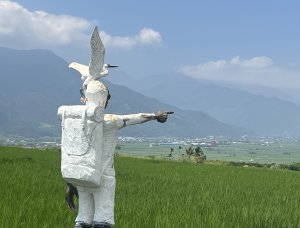
Guishan Island (龜山島), also known in English as Turtle Island because of its distinctive turtle-like silhouette, eventually provided an opening for a conversation across the Pacific. The project’s starting point, however, remained the practical knowledge through which island residents understood the sea.
In Seattle, I explored these questions in a new setting. Museums, markets, Taiwanese American communities, and public cultural events in Seattle offered different perspectives on how places remain connected through people, objects, knowledge, and values. The central question was not simply what could be learned from American institutions, but how these relationships could be recognized, interpreted, and sustained through cultural work.
From Local Navigation to Cultural Sea Routes
For Guishan Island’s fishers, the sea was never an empty expanse. It contained routes, turning points, fishing grounds, currents, and familiar landmarks. Knowing when to leave a harbor, where to fish, and how to respond to changing conditions required repeated journeys, observation, bodily memory, and intergenerational exchange. A sea route therefore involved more than distance: it expressed a practical relationship between people and a changing environment.
Grounded in these local practices, I brought a central question to Seattle: could following the journeys of objects, food, and people help me understand connections across the Pacific? I define this practice-based approach as “sea-route studies”: tracing the marks that human movement leaves across places over time. I understand a sea route not simply as a shipping line, but as a history of people, objects, knowledge, and practices moving along it. Similarities between distant places can prompt questions about migration and exchange, though each connection needs evidence. Movement is uneven, and communities develop differently in new settings; comparison asks both what continues and what changes. I use “cultural sea routes” to describe these evolving relationships.
Historical materials give this inquiry substance. Caspar Schmalkalden’s map Insula Formosa, dated to 1648 in the Lanyang Museum’s account, identified the region associated with the Kavalan people as “Cabaran.”¹ Such maps recorded places while also reflecting the interests of navigators, traders, and colonial authorities.
By the early twentieth century, Nippon Yusen Kaisha’s route maps placed Taiwan, Japan, and North America within an interconnected shipping network. The map used here, N.Y.K. LINE — Map Showing the Routes and Ports of Call of N.Y.K. Steamers (c. 1923), was produced by Nippon Yusen Kaisha (NYK) and is held by the Noel Butlin Archives Centre at the Australian National University. The map provides historical evidence of a shipping network linking Taiwan, Japan, and North America. It gives a concrete route framework for investigating how people moved and influenced one another, although individual journeys still require further records. These trans-Pacific lines must also be read alongside colonial power and immigration restrictions, which shaped who could move and under what conditions.

The Kuroshio gives the project its name and an image of movement beyond the island. Flowing northward past Taiwan toward Japan and eastward through the Kuroshio Extension, it encourages me to look beyond territorial boundaries. It is not a direct route from Guishan Island to Seattle. Rather, it is a reminder to ask how people and places become connected—and to distinguish historical evidence from the comparisons and possibilities that a journey inspires.
Two Turtle Islands: A Shared Name, Distinct Histories
The phrase “From Turtle Island to Turtle Island” begins with a shared name. In some Indigenous North American traditions, Turtle Island belongs to specific accounts of creation and relationships among humans, land, water, and other forms of life. These traditions have distinct communities and histories; they do not constitute a single narrative shared by all Indigenous peoples.
For me, the shared name is an invitation to listen, not evidence of a common origin. It requires respect for Indigenous sovereignty and for the people who hold and share this knowledge. Traditions elsewhere in North America should not be assumed to represent those of Seattle’s Indigenous communities.
Place-names make this question tangible. Seattle takes its name from Si’ahl, a leader connected to the Duwamish and Suquamish peoples. In Yilan (宜蘭), the character “lan” (蘭) carries forward the older name Kavalan (噶瑪蘭), retaining a connection to the Indigenous Kavalan people and the history of the Lanyang Plain. Yet the continued use of a name does not guarantee that its histories are understood. Cultural work must also ask who continues to speak, transmit knowledge, and participate in interpreting a place. Similarity opens the conversation; attention to difference allows it to continue.
From Museum Objects to Living Knowledge
Seattle’s museums made trans-Pacific relationships tangible. At the Burke Museum, a Tao tatala canoe from Lanyu, Taiwan, offered a distinctive object history. According to the museum’s account, restaurateur Ivar Haglund acquired two canoes during a visit to Taiwan in the 1970s and displayed them at Ivar’s Salmon House. A later collector purchased them and donated the better-preserved canoe to the Burke. The Tao community also gifted the collector the missing moroung feathered finials, which he subsequently donated to the museum.
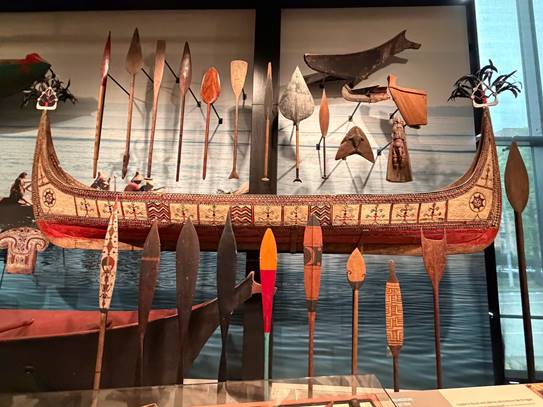
This history concerns not only distance but changing meanings. A vessel associated with fishing, craft, and community life became a restaurant display and later a museum object. Its movement raises questions about provenance, interpretation, and the knowledge that may be lost when an object becomes separated from its makers. Preservation therefore involves more than maintaining material form; renewing relationships with source communities can also be essential to understanding what is preserved.
A painted deerskin panorama in the Seattle Art Museum’s collection provides another perspective. Depicting Tainan and the forts Zeelandia and Provintia, the work preserves traces of Taiwan’s historical landscape within an overseas collection. Its presence invites local history into conversations about art and maritime exchange, while also raising questions about how places are named and classified. Research from Taiwan can contribute to those interpretations, just as materials preserved abroad can return as resources for local historical understanding.

At the Wing Luke Museum, a pink Toshiba rice cooker brought the inquiry closer to home. It reminded me of the familiar Tatung cooker in Taiwan. Rather than treating this resemblance as proof of a technological connection, I began with a simpler question: how does an everyday appliance become part of someone’s sense of home? Alongside the canoe and painted panorama, the rice cooker suggested another way to follow cultural journeys—through objects people use, remember, and carry into new lives.

Markets extend that inquiry into public life. Pike Place Market brings food trading together with small businesses, residential life, and social services. It prompted a reconsideration of Daxi Fishing Harbor, where the rhythmic cadence of auction calls in Taiwanese and the sharp clatter of crushed ice give everyday work an audible texture. Alongside seasonal catches, trading expressions, and fishers’ observations of marine conditions, these sounds belong to a working body of cultural and ecological knowledge. The question was not how to reproduce Seattle’s market, but how such practices might support cultural education without disrupting livelihoods.

Together, the canoe, panorama, rice cooker, and market changed how I thought about preservation. Caring for cultural objects also means attending to the people who make, use, and interpret them. That lesson connected my museum visits with the everyday work of a fishing harbor.
May in Seattle: Taiwanese American Culture in Everyday Life
In May 2026, I attended the Taiwanese night market at the University of Washington. The visit unfolded within a wider month of cultural programming across Greater Seattle, including the Music of Taiwan concert, the performance program We Are Taiwan (《看見臺灣》), the Mariners’ Taiwanese Heritage Night, Taiwanese film screenings, and a Taiwan Day Dinner at the Mercer Island Community Center. These events provided different settings in which Taiwan could be encountered: a campus, a theater, a ballpark, and a shared table.
The Music of Taiwan concert illustrates how performance can carry community history. Its participating choirs presented songs alongside accounts of their own development, connecting music with the experiences of the people sustaining it. What stayed with me was how individual memories could become a shared sound. Singing offered younger generations and friends from other backgrounds a way into language and memory, much as shared meals offered a connection through taste.

For people who have built families and working lives in the United States, migration need not end their relationship with Taiwan. That relationship may instead depend increasingly on practices of gathering, learning, and participation. First-generation memories and the perspectives of American-born descendants need not converge into one account of Taiwanese identity. For my sea-route approach, the future possibility lies in this capacity for culture to endure and change after migration. Practices carried from one place can enter into dialogue with local cultures, overlap with them, or blend into new forms. I understand this as the potential for a more diverse cultural ecology: inherited traditions and new ways of living developing alongside one another, rather than migration simply erasing what came before.
These gatherings taught me to look beyond recognizable Taiwanese symbols. I began asking who organized an event, how different generations took part, and what continued afterward. Culture endured through the repeated work of bringing people together, not only through major institutions or celebrations.
With the support of James Lin and the UW Taiwan Studies team, these observations could also enter academic discussion. On May 14, Michelle T. King discussed her book Chop Fry Watch Learn: Fu Pei-mei and the Making of Modern Chinese Food, situating familiar cookbooks and television memories within questions of family, gender, technology, media, and cultural identity.² The discussion showed me how everyday experiences could become starting points for research—a useful lesson for my own work with island stories and harbor life.

I came to see Taiwanese American communities as potential collaborators, not simply audiences for culture from Taiwan. Their experiences could help reshape the questions I brought from Yilan, while our local work could contribute to conversations abroad. Exchange could move in both directions.
Home After Relocation: Memory, Power, and Diaspora
Taiwanese American experiences also offered a point of comparison with Guishan Island’s relocation history. In the postwar period, state military policy led to the collective relocation of Guishan Island’s residents to Yilan on Taiwan’s main island in the 1970s, and subsequent concerns about resettlement, land, and compensation show how state decisions continued to shape life after relocation. This state-directed relocation cannot simply be equated with the varied educational, professional, family, and politically shaped movements through which Taiwanese people have settled in the United States.
The differences matter: who could choose to leave, who faced pressure, and who could return? The comparison is not between identical migration histories, but between efforts to sustain community identity in a new place: Guishan Islanders in Yilan and Taiwanese migrants in the United States. Both bring me back to a question in our work: how does home remain meaningful when everyday life has moved elsewhere? Guishan Island’s memory continues through family ties, fishing knowledge, rituals, food, and stories. Among the Taiwanese American communities I encountered, language and gatherings kept Taiwan present under different circumstances.
I began to think of belonging as something people practice, not simply something they inherit. Cultural work can help us remember where we come from while also helping people of different backgrounds build a life in the same place.
From Cultural Identity to Public Participation
In my use of sea-route studies, the continuity lies in human movement and exchange, not in a single mode of transport. The framework follows these relationships beyond shipping into air travel: the vehicle changes, but the inquiry still concerns people moving between places. Nor is it limited to belonging and identity. People also exchange ideas about democracy, rights, and public participation. This leads me to ask how postwar exchanges with the United States influenced Taiwan’s democratic development, and how people in Taiwan debated and reshaped those ideas. Seattle Pride offered one contemporary example through which to explore the public expression of equality and inclusion.
In June 2026, I joined the Taiwan contingent at the Seattle Pride Parade. The Taiwan Tourism Administration’s San Francisco Office worked with local Taiwanese communities and international participants, using a rainbow float, Taipei 101 imagery, Taiwanese popular music, and bubble-tea imagery to establish a recognizable presence. Its “Rainbow Bridge” theme explicitly connected Seattle and Taipei through a message of love, freedom, and inclusion.
The scene showed how familiar symbols acquire meaning in different public settings. Bubble tea could evoke taste and home while also becoming a medium of identity and participation. Taiwan’s presence connected cultural representation with discussion of LGBTQ rights and marriage equality. Taiwan became the first country in Asia to legalize same-sex marriage through the Act for Implementation of J.Y. Interpretation No. 748, which took effect on May 24, 2019.³ The legal process involved constitutional interpretation, legislation, social movements, and democratic debate rather than a simple transfer of values from abroad.
For me, the night market and Pride revealed two ways of taking part in public life. One invited people to gather around food and performance; the other linked familiar cultural symbols with rights and inclusion. Neither represented every member of a community, but both showed how participants helped shape what Taiwan could mean abroad.

What I Learned About Following Connections
Seattle helped me turn an emerging idea into a more careful way of working. The Burke canoe offers one example: the museum’s account traces a documented journey from Taiwan to a restaurant and then a collection. That history supports questions about changing uses and meanings. The rice cooker, by contrast, prompted a comparison through familiarity; resemblance alone does not establish the same kind of historical route. For me, these are connected stages of inquiry: tracing movement where records exist, comparing what communities retain and transform, and asking what new cultural relationships may develop. The future possibility lies not only in new collaborations, but in how cultures endure, interact, and take new forms after people move. Distinguishing documented connections from suggestive similarities keeps this inquiry grounded.
I also came to understand that following an object is only part of the work. Interpretation depends on who speaks, who is consulted, and what knowledge people choose to share. My questions began in Yilan, but they needed room to change through dialogue. Listening and checking interpretations with others are part of the inquiry itself.
The most practical lesson was that a connection needs time. A visit can begin a conversation, but shared work and trust develop through returning to it. I now think less about how many places a cultural sea route can connect and more about whether the people involved find reasons and resources to keep working together.
Returning to Yilan: Toward a Cultural Harbor
Back in Yilan, I hope to carry these lessons into Seabelongings’ next phase: developing a Cultural Harbor. I envision a local gathering place and program of activities where residents, migrants, fishers, artists, researchers, and younger generations can share their histories and knowledge. Building on our existing work and Pacific connections, the initiative will begin with small activities and grow as resources and partnerships allow. Three directions will guide it.
Collaborative Art and Community Memory
We plan to develop oral histories, harbor soundscapes, and relocation stories into sound works, small publications, and community exhibitions. Residents will help shape how their contributions are presented and shared. Meals, guided walks, and workshops will offer ways to take part, with materials that can be used again in local education. The voices of residents and the sounds of working boats will remain expressions of lived knowledge, not simply a backdrop.
Marine Knowledge and Environmental Learning
We will invite fishers, educators, and researchers to discuss currents, species, seasons, and coastal change. Workshops and shared learning materials can bring local observations into conversation with scientific research while recognizing their different strengths and limits. The aim is to help residents and visitors understand both the marine environment and the livelihoods connected to it.
Reciprocal Exchange Across the Pacific
We will maintain contact with the UW Taiwan Studies network and explore shared archival research, online conversations, and small exhibitions with Taiwanese American communities, museums, and cultural organizations. Exchanges with Japanese, Filipino, and other Pacific communities can develop through mutual interest. Each collaboration will depend on agreement about responsibilities, resources, permissions, and language support, with useful outcomes returning to the people who contribute.
Before expanding, we will review the workload, participation, consent, and usefulness of what we produce. For me, success will mean that people gain knowledge and relationships they can continue to use, retain a say in how their stories are represented, and strengthen their ability to care for the place they share. International visibility may follow, but it is not the main goal.
Deeper Understanding, Wider Connections
On returning to Yilan, I found Guishan Island in its familiar place offshore, but my questions about it had grown wider. The canoe in Seattle, the rice cooker, the market, and the community gatherings gave me new ways to think about the stories and working knowledge close to home.
For me, Fulbright showed how far a question that begins in one local place can travel—and how much it can change along the way. The “echoes” of the Kuroshio describe that movement outward and back: fish-auction calls, voices joining in song, and stories finding new listeners. Exchange helped me look more closely at Yilan, not leave its everyday concerns behind.
From Turtle Island to Turtle Island, an island offers a place to begin, but people keep the route open. My next task is to continue the conversations, create opportunities for shared work, and bring what I have learned into the place I call home.
Notes
- Caspar Schmalkalden, Insula Formosa. The map is reproduced and dated to 1648 in the Lanyang Museum’s newsletter, no. 124. For its manuscript context, Schmalkalden’s illustrated travel account is preserved at the Forschungsbibliothek Gotha, University of Erfurt, shelfmark Chart. B 533. The library describes the manuscript as having been compiled after his return from his travels in 1652; the museum’s dating of the map should therefore be distinguished from the compilation date of the surviving travel manuscript.
- Michelle T. King, Chop Fry Watch Learn: Fu Pei-mei and the Making of Modern Chinese Food. The UW Taiwan Studies Program records King’s book presentation on May 14, 2026.
- Act for Implementation of J.Y. Interpretation No. 748, promulgated on May 22, 2019, and effective from May 24, 2019. The Act followed Judicial Yuan Interpretation No. 748 of 2017.
Acknowledgments
I am grateful to Fulbright Taiwan and the Ministry of Culture for making this exchange possible, and to James Lin and the UW Taiwan Studies team for their guidance, support, and access to university, library, and museum resources. I also thank Lucy Li at the Tateuchi East Asia Library for helping me locate historical maps and research materials and pointing me toward further collections, including those at the Library of Congress.
My thanks also go to Ellen Chang for introducing me to Seattle’s arts and cultural life through film screenings, events, and activities such as Seattle Pride. Beyond Seattle, Taiwanese and Taiwanese American communities in California, Boston, and New York welcomed me into activities, interviews, and conversations. Their generosity widened the questions I brought from Yilan and made this exchange a shared experience.