Introduction: The Internal Ascent
When I first received the notification that I had been awarded the Fulbright Senior Scholar award, my initial reaction was excitement and joy. There was the undeniable thrill of professional validation, certainly, but it was quickly shadowed by a hesitancy related to leaving my comfort zone for a country where I did not speak the native language.
During those early weeks of preparation, I found myself returning often to a quote by Sir Edmund Hillary: “It’s not the mountain we conquer, but ourselves.” As an avid hiker, this became the silent mantra of my journey. To truly experience Taiwan as a Fulbright Scholar, I had to lean into a growth mindset—embracing the steep learning curve of a new culture and welcoming the professional challenges that come with cross-cultural collaboration.
The Research: A Super-Aging Laboratory
My career has been dedicated to optimizing medication use in older adults to support healthy aging. It is common for people to take more medications than they need and polypharmacy often leads to adverse drug events that impair quality of life. Recently, a new public health concern has emerged: the rise of sedentary behavior. While we understand that “sitting is the new smoking,” we lack a clear understanding of whether medications may promote this inactivity. Many common medications, specifically CNS-active drugs such as sedatives, cause dizziness, drowsiness and reduced attention. While these medications are linked to falls, I suspected a more subtle “pre-fall” impact: do these medications make older adults so fatigued that they simply reduce their movement?
Taiwan, a “super-aging” society where over 20% of the population is aged 65 or older, provided the ideal laboratory to investigate this question. It offers a glimpse into the future of global demographics, supported by a world-class healthcare infrastructure.
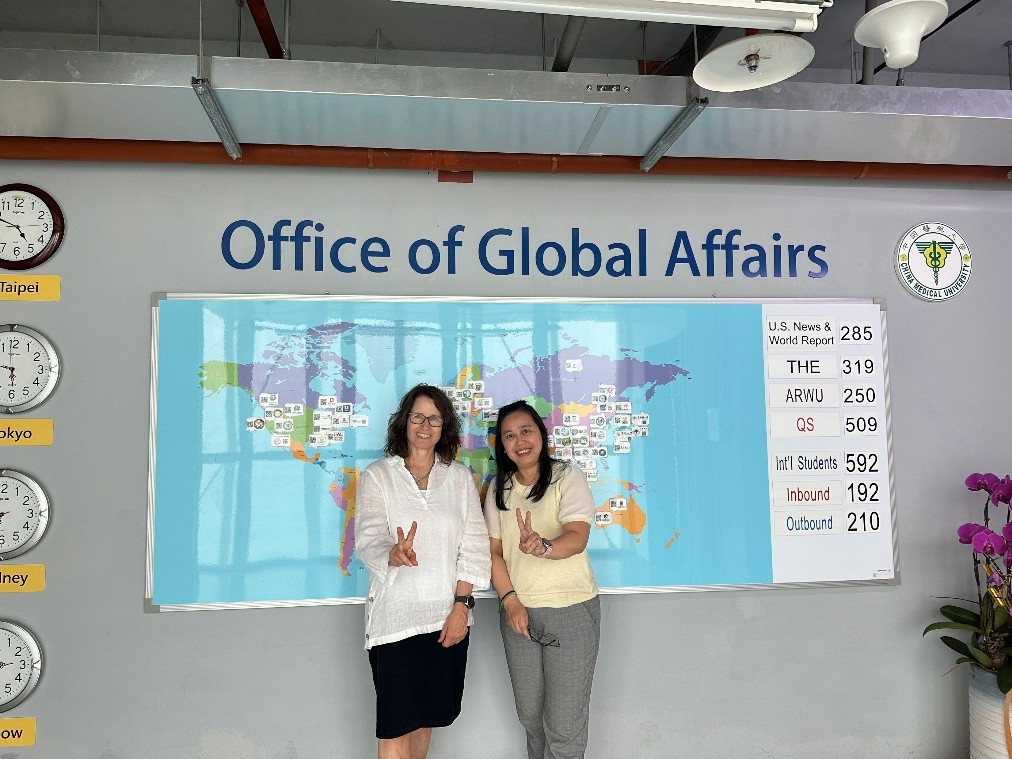
Taichung proved to be more than a host city; it became a scholarly home. My host, Professor Hsiang-Wen Lin at China Medical University (CMU), welcomed me as a true partner. Her expertise in pharmacoepidemiology mirrored my own, creating a seamless intellectual bridge between our research.
This bridge soon expanded to include Professor Edward Chia-Cheng Lai and Daniel Hsiang-Te Tsai from National Cheng Kung University (NCKU). Together, we delved into Taiwan’s national healthcare databases—a researcher’s dream that allows for granular, longitudinal analysis of medication harms not often possible in the United States. This collaboration enabled us to compare this research question in Taiwanese and American data, seeking to understand how cultural healthcare practices influence the risks associated with CNS-active medications.
The academic community at CMU integrated me into their scholarly life, with several invitations to delicious dinners and cultural events. Beyond our formal research, I mentored pharmacy graduate students in research and guided them through completion of a systematic review on the topic of medications and sedentary time. I had the privilege of presenting at five professional pharmacy conferences across Taiwan on topics related to fall prevention and the optimization of medications in older adults and gave four presentations at CMU to students and faculty. I submitted three articles during my time in Taiwan and have three manuscripts in progress. Whether visiting the state-of-the-art Geriatrics hospital in Taichung or the Traditional Chinese Medicine Pharmacy at CMU, I witnessed a holistic approach to health with the seamless blending of cutting-edge Western medicine with deeply rooted Traditional Chinese Medicine.
Expanding the Network: Rural Access and Future Horizons
A significant highlight of my visit to Taiwan was meeting with Dr. Chen-Yu Wang and colleagues at the National Center for Geriatrics and Welfare Research. Our conversation moved beyond the urban hubs of Taichung and Taipei to address the unique challenges of Taiwan’s aging rural communities. Dr. Wang’s innovative work—utilizing community centers to optimize medication use—resonated deeply with my own commitment to advancing health equity.
This meeting sparked interest in future collaborations centered on fall prevention that will extend far beyond my six-month residency. We are already planning my return in October 2026, where I will deliver a keynote presentation at the International Conference of Healthy Ageing and Community Resilience held by the National Health Research Institutes (NHRI).
Cultural Immersion: Beyond the Tourist Lens
The Fulbright mission is often described as “cultural diplomacy,” but that phrase feels too formal for the warmth I experienced. My time in Taiwan was a symbiotic journey where academic research was enriched by the profound “human-centric” culture.
I moved beyond the “tourist lens” through the incredible generosity of my colleagues. Being invited into a home for Lunar New Year was a profound honor—an invitation into the heart of Taiwanese identity. I watched as generations gathered, sharing food that carried special meaning.
This immersion was most evident in my exploration of Taiwan’s religious landscape. Temples in Taiwan are vibrant community hubs that foster social cohesion. But when my colleagues involved me in the rituals—the lighting of incense, the offering of prayers—the experience became personal. I was fascinated by the harmonious blend of Taoism, Buddhism, and folk religion. This religious fluidity is a mirror of the Taiwanese people themselves: resilient, adaptable, and deeply respectful of others.
Back to the Mountains
Beyond the analytical confines of my research, I sought a deeper understanding of Taiwan’s ethos through the natural world. My lifelong passion for hiking served as a vital bridge between physical endurance and mental clarity—a literal manifestation of “conquering the mountain within.” Whether navigating the high-altitude ascent of Jade Mountain (Yushan), trekking to Jiaming Lake, or exploring Kenting National Park, these challenging hikes served as a physical reminder of my resilience. They mirrored the challenges of navigating a new culture.
Conclusion: The View from the Summit
As I transition back to my role in the United States, I am filled with profound gratitude for Professor Lin, the faculty at CMU and NCKU, and the students who patiently helped me navigate the nuances of Taiwanese life.
The hesitancy I felt at the beginning is now a distant memory. Throughout this journey, I discovered that true communication often lives in the space between words: in the warmth of a shared meal, listening to people’s life stories, and laugher among new friends.
Looking back on this experience, I am reminded of the mantra that guided my preparation. My time as a Fulbright Scholar was never just about navigating a new geography or complex healthcare database; it was about conquering the “mountain” of my own perceived limitations. I returned home not just with new research collaborations, but with a transformed sense of what is possible when embracing the unknown.