One of my favorite things to do when traveling is to drink coffee. A drink as universal as it is diverse, coffee is found the world over, yet everywhere it evolves differently, rendering each cup a window into the palate and perceptivities of its people. In Italy, coffee is quick, an espresso drunk standing at the counter on the way to work in the morning. Japan favors precision pour-overs that resemble a tea ceremony: meditative and curated. Coffee in Taiwan was unknown to me prior to my time there, but it has quickly become one of my favorites, as it is home to perhaps some of the most unique coffee I have tried in all my travels. Avocado lattes, cactus americanos, watermelon iced coffees, osmanthus jelly espresso, and perhaps my favorite, iced sweet potato lattes. In the nine months I spent as a Fulbright research fellow, I came to believe that designing in Taiwan is best thought of in terms of Taiwanese coffee: taking risks on unlikely combinations can produce delightfully unexpected new flavors.
Taiwan itself has a hard-to-pin-down quality. As a lasting result of its layered history, it is often described by a complex combination of what it once was, what it is similar to, or what it currently is not. In the field of design, this is also true. The idea of ‘Taiwanese design,’ to many, requires some clarification. Are you referencing indigenous Austronesian peoples’ design, Hoklo and Hakka influence, Japanese colonial style, contemporary international influence, or something in between? I was drawn to Taiwan to answer a question: what is the Taiwanese material landscape, and how can I represent it through the medium of furniture design? It wasn’t until arriving that I realized the scope of that question and the many ways I could attempt to answer it.
Distilling this research question from a library’s worth of answers to one I could metabolize over the course of nine months was my first challenge. However, thanks to the coordination efforts of Jingjing Young (楊晶晶) at my host institution, Songshan Cultural and Creative Park (松山文創園區), I was able to meet with many Taiwanese designers who helped me to frame my practice for the coming months. Gaining insight into these designers’ practices, influences, and limitations gave me valuable perspectives on Taiwanese design. To many of these designers, the city of Taipei itself seemed to be a leading character in their stories; they often found ways to blend Taiwanese culture with contemporary materials that felt both personal and relatable. Meeting the founder and lead designer of DOT Design (點睛設計), Lance Han (韓世國), I had the opportunity to see some of his designs that were thoughtful portraits of the island: a stool made from recycled plastics in the shape of a canelé pastry, bags made from decommissioned China Airlines life vests, stone diffusers made from marble salvaged during the natural history museum’s renovations. It was through these discussions with Lance Han, and other designers, that I was able to focus my question down to researching Taipei, the city itself, and its unique material landscape.
Through the encouragement of the many designers I met with, I felt emboldened to form a relationship with Taipei through circuitous routes. Always finding a different path, I pored over as much of the city as my legs would allow. During my searching, one place immediately left a strong impression on me: the Guang Hua Digital Plaza (光華商場) area. Abutting National Taipei University of Technology (國立臺北科技大學), it buzzes with mostly college students; young engineers mill into cramped stores in search of Arduinos, breadboards, and cheap hong dou bing (紅豆餅, red bean cakes) to fuel late-night tinkering and bug-solving sessions. I was entranced by the seemingly endless buckets of meticulously organized computer components. I once went through every resistor bucket in a single store, one by one, each banded with a different sequence of colors to denote how many ohms it would resist in a circuit. I knew none of that at the time. I simply felt like a kid in a candy store, wandering aisles of sweet things, delighting in the colors and sheer breadth on display. I remember thinking very clearly: I wish I were an engineer, someone who could actually use these components. I had never had this much immediate access to such specific parts, and as a furniture designer I had no use for much of it. I had barely finished the thought when a lightbulb went off: I had not come to Taiwan to use materials I was already familiar with; I came to find and reflect the materiality of this city through furniture design. Perhaps understanding and finding a way to use these components in a piece of furniture was exactly how I could most honestly represent both this spectacular city, and my experience in Taipei.

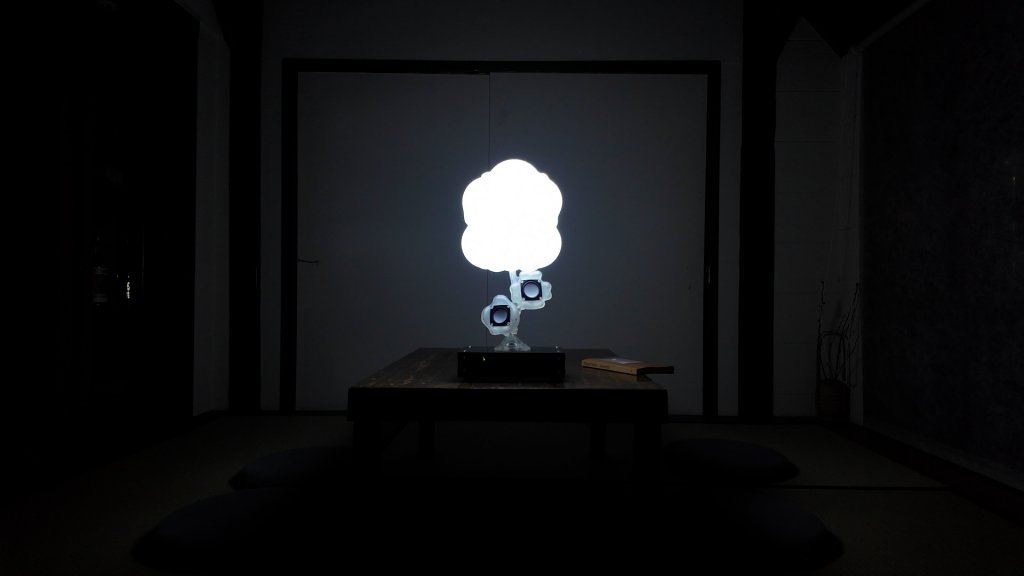
It was not long after this encounter that I decided to build a lamp that possessed faculties for conversation. Making a lamp talk necessitates a complex system of diverse componentry, all of which I could source from the Guang Hua area. Although complicated, restraint was not a priority in this project. I felt compelled to make a design that brought back that feeling I had of discovering Guang Hua for the first time, exciting, bright, and maybe a little overstimulating. The process of working on the lamp made me feel like a composer with an orchestra of speakers, microphones, LED strip lights, switches, buttons, a Raspberry Pi (the computer, or ‘brain,’ of the lamp), a buck converter, a 12V power supply, as well as a smattering of resistors, diodes, and MOSFETs. It was my job to find a way to have it all come together to produce a hymn of circuitry, and not an electrical fire.
It isn’t hyperbolic to say I could only have made this project in Taipei. . As I was working, I was repeatedly reminded of how difficult this project would have been to make in the United States. Ordering parts online, waiting a day or two, if anything is incorrect, having to order again, wait and repeat. All that wasted time and energy in shipping and materials was not a barrier in Taipei. I could visit the Guang Hua area practically any time, day or night, and find exactly what I needed; mistakes took practically no time to fix, and as a result I was able to adapt and problem-solve at a rate that felt shocking.

The lamp “EL1ZA” (named after ELIZA, the world’s first chatbot, developed at MIT in 1966 by Joseph Weizenbaum) can have conversations with the user. But why make a lamp talk? Partly to cram in as many components from the Guang Hua area as possible. However, I also wanted to use EL1ZA as a commentary on the technology we are increasingly inviting into our homes. EL1ZA was built with a personality that is generally disinterested, disagreeable, and petty, often mocking the user or doing the opposite of their request. Irony and humor are qualities I enjoy in design, and the idea of a lamp with no on/off switch, one that requires a computer and an overly difficult negotiation on the part of the user, felt equally ridiculous and frustrating, yet not a far cry from reality. There are refrigerators with smartphones built into them and cameras on our doorbells. Design has increasingly become a way to insert technology into domestic objects in a manner that, in practice, often operates more like surveillance than convenience. So EL1ZA became a way for me to work through some of my own feelings about being a designer in this age of fast-paced, ever-evolving technology, while also serving to embody the marvel I felt in Guang Hua Digital Plaza, and sentimentally as a love letter to the city of Taipei.
Finishing the lamp, and my time in Taiwan, brings me back again to sweet potato lattes. The beauty I found here as a designer was in these unlikely combinations: sweet potato and espresso, a lamp and human speech. The very thing that made Taiwan difficult at first, its hard-to-define nature, turned out to be the source of the inventiveness and boundary-pushing I found in myself while living here. I came curious to find ways to represent the material landscape of Taipei. I am leaving with a wider sense of what’s possible, and the confidence to keep reaching for combinations of the unexpected.