Curiosity, Connection, and Kuai Kuai: Reflections from Taiwan
A few days after returning from my time in Taiwan where I participated in the Fulbright International Education Administrators (IEA) Seminar, I walked down the hall to visit our Application and Development offices at Penn State Global. We call them our AppDev team, the people who keep everything running behind the scenes. I had four bags of Kuai Kuai chips in hand. Partly as a snack, but mostly as a story.
In Taiwan, these bright green bags are more than just snacks. They’re placed on top of computers and servers as a kind of good-luck charm to keep technology running smoothly. Two weeks earlier, I had never heard of them. But on our first day of visits in Taipei, the 2026 IEA cohort was introduced to Kuai Kuai and, instantly, a group of 16 international educators from the U.S. became completely taken with this small but meaningful cultural tradition.
Standing there with our AppDev team, explaining why I was encouraging them to place snack foods on their equipment, I realized how much that moment captured for me. Not just the humor or novelty of it, but the way something simple can open a door to curiosity, to connection, to understanding. Bringing that story back, and seeing the interest it sparked, reminded me why experiences like the Fulbright IEA program matter. It reconnected me to the kind of global curiosity that gives purpose to the day-to-day work of an International Educator and the reason it matters in the first place.
I went to Taiwan with a clear purpose: learn from Taiwanese institutions, explore potential collaboration, and engage with colleagues across the U.S. who are all doing this work in different ways. But like many of the most meaningful professional experiences, what I came away with feels more difficult to summarize. Yes, there were thoughtful, well-organized and genuinely productive meetings. Yes, there were conversations about mobility, language programs, research collaboration, and how institutions in Taiwan and the United States can work more closely together. But what has stayed with me most is something a little less tangible: a renewed sense of why this work matters.
Showing up still matters
We spend a lot of time in international education talking about connections. We build systems and structures to support it, then we measure it and then we report on it. But being in Taiwan was a reminder that none of that replaces simply showing up. There is a different kind of understanding that comes from being in the room with colleagues, walking their campuses, hearing how they talk about their work, and seeing firsthand how they approach global engagement. It adds dimension in a way that emails and virtual meetings just do not.
What stood out to me across institutions was a shared sense of purpose. While the contexts are different, the core questions feel very familiar: How do we prepare students to engage in a global environment? How do we support international students in meaningful ways? How do we build partnerships that are not just active, but intentional?
Those conversations felt easy in the best way, not because the work is simple, but rather because there is a clear alignment around what we are all trying to do.
A reset on curiosity
In my day-to-day role, a lot of my work focuses on logistics, policy, and problem-solving.Taiwan gave me a chance to step outside of that pace and reconnect with curiosity in a more open-ended way. The very reason I care so deeply about this work in the first place is rooted in my own global curiosity.
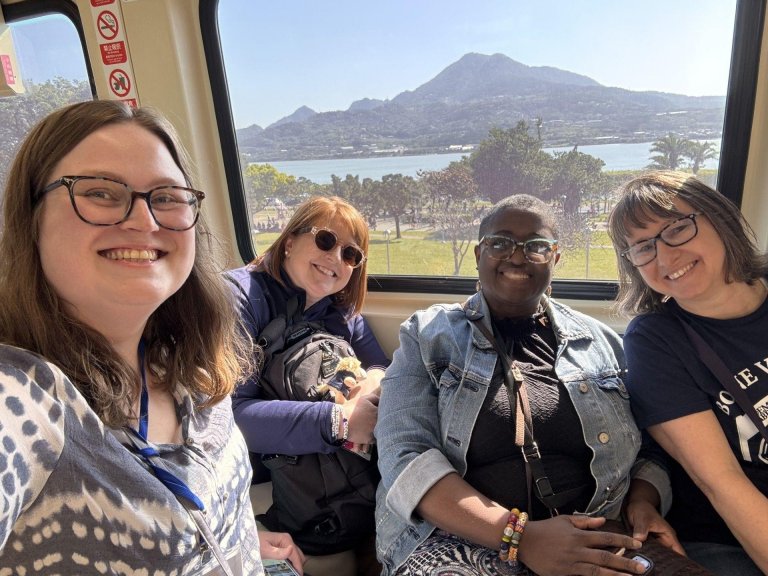
It showed up in small moments while bonding with my fellow cohort like figuring out public transportation, navigating night markets and restaurant choices, exploring Taipei 101, end of the day runs to 7-Eleven (we were smitten with strawberry flavored Snickers) and conversations on the high-speed rail. It also showed up in more intentional ways, like asking different questions during institutional visits. Not just “How does this program work?” but “Why does it work this way?” and “What can I learn from this approach?”
Partnerships grounded in alignment
One of the most valuable parts of the experience was the opportunity to think more concretely about partnership. It helped us consider not just where opportunities exist, but where there is real alignment.
Taiwan’s higher education system offers strong possibilities for collaboration, particularly in areas like language education, student exchange, and research. But what made the conversations meaningful was not just identifying those opportunities but understanding how our priorities intersect.
At Penn State, we think a lot about access, student support, and creating meaningful global experiences that are integrated into the academic journey. Hearing similar priorities reflected in Taiwanese institutions made it easier to imagine global education initiatives that are not just feasible, but sustainable.
That distinction matters.
Carrying it back to Penn State
Coming back from something like this always brings the same question: what now? The reality is that my daily work does not slow down. But I do think experiences like this shift how I approach it.
It means being more intentional in how I think about collaboration and taking the time to build relationships and connections. It means continuing to ask better questions, even when time is limited. And it means keeping that sense of curiosity present, even in the more routine parts of the work.
It also reinforces the importance of creating opportunities like this for others, whether that’s staff, faculty, or students. Because the impact of being in a different context, even for a short time, is hard to replicate any other way.
Gratitude, and forward momentum
I am incredibly grateful to have had the opportunity to participate in the Fulbright IEA Seminar and for the thoughtful way it was organized and hosted. I can already see how lasting friendships were forged in just two short weeks. The moments of connection that happened over learning about something new, while navigating unknown places can never be duplicated. What matters now is how that perspective translates into action. The relationships built, the ideas exchanged, and the questions raised. Those are the things that will continue to shape my work moving forward.
In the end, that is the value of international education at its best.
And maybe that’s why I keep coming back to those bags of Kuai Kuai sitting on our AppDev team’s equipment. A small, unexpected tradition that made its way from Taiwan to Pennsylvania, carrying with it a story, a laugh, and a moment of connection. It is a simple reminder that international education is not only built through agreements or formal programs, but also through the exchange of ideas, perspectives, and even the smallest cultural details that stay with us. Those are the things that spark curiosity, build relationships, and give meaning to the work we do every day.