Taiwan has remained in the backdrop of my reading landscape since I was ten years old.
I grew up in China reading essays, poetry, plays, choreography and novels by Yu Kwang-chung, Lin Chin-hsuan, Chu T’ien-wen, Lin Hwai-min, Sanao and Pai Hsien-yung. For years, I have taught the cinematography of Edward Yang and Hou Hsiao-Hsien in my Asian cinema lessons. I thought I knew Taiwan before my Fulbright IEA seminar; I was both right and wrong.
Today, as a Communication Studies faculty member at Bellevue College, a community college just outside Seattle, my journey to Taiwan revisits my childhood memories, while at the same time, building new professional ties that take me into the future.
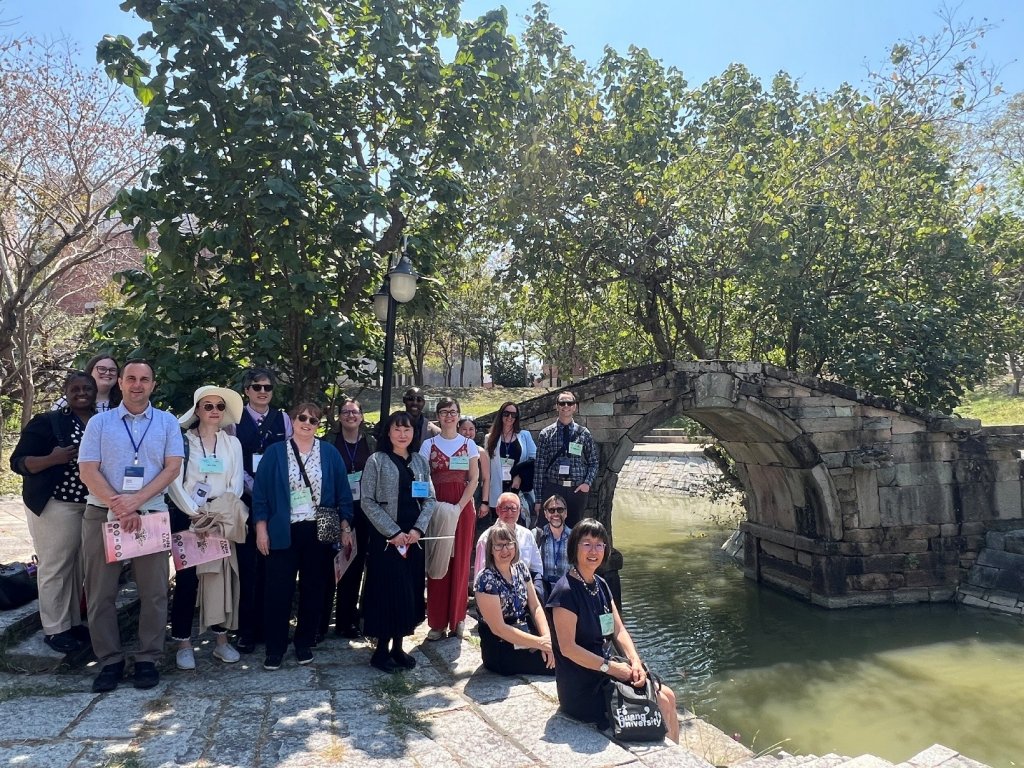
On many occasions, my Fulbright IEA seminar has facilitated for me new discoveries of Chinese history and culture. At Taipei Palace Museum, while going through traditional Chinese landscape, or Shanshui paintings by Ma Yuan of the Southern Song dynasty and the rubbing, made during the Ming dynasty (1368-1644) of Wang Xizhi’s (303-361) cursive and running scripts, Kuài xuě shí qíng tiē 快雪時晴帖, I saw Taiwan’s deep connection to a Chinese cultural legacy. On many university campuses we visited, I saw such legacy carried through into the new age by contemporary Chinese scholar gurus. At Tainan National University of the Arts (TNUA), we saw an entire stone bridge, moved brick by brick, and meticulously reassembled here in Tainan, from Yuyao County of China’s Zhejiang province. In Taipei, we all took pictures under the Fu Bell at National Taiwan University (NTU), initially established by Fu Ssu-nien (1896 — 1950). Dr. Fu also served as the acting president of Peking University in 1945, which made this moment especially personal to me, a graduate of Peking University, standing under the Fu Bell some eighty years later. At National Cheng Gung University in Tainan, I’ve learned that it was on this campus where Prof. Su Xue-Lin (1879 — 1999), who studied under Hu Shih and abroad in France, and who is known as one of the first-generation female writers in the modern history of Chinese literature, has taught, lived and retired. As an instructor actively looking for content in this area, I have more to discover and learn here.
Part of my goals participating in this Fulbright IEA trip was to continue with the success facilitating faculty dialogues and teaching collaborations, as recently achieved through our inaugural workshop completed with China Academy of Art in Hangzhou, China. During that workshop, faculty from Bellevue College and China Academy of Art participated in seminars and field trips, shared teaching scholarships that centered around the notion of “Shanshui”, or the philosophy and aesthetics reflected through traditional Chinese landscape painting. Between the Shanshui workshop and this Fulbright IEA seminar, I saw the parallel emphasis on cross-cultural dialogue, collaboration and legacy; this insight gave me inspiration for my future projects.
At the same time, Taiwan is connected to the rest of the world beyond the Chinese cultural circle. For each campus we visited, we not only met and talked with students locally born in Taiwan, but also international students studying here from Southeast Asia, Europe and America. In addition to receiving Fulbright scholars to conduct their teaching and research project here in Taiwan, the Fulbright Commission in Taiwan is actively supporting their teaching assistants, selected from college students in Taiwan, for their upcoming teaching assignments in the U.S., supporting a Chinese language instructor in their classrooms around the country, from Wisconsin, Texas to North Dakota.
Such two-way, people-to-people exchange is growing out of a city with cultured residents open to diverse, sophisticated experiences. In addition to the planned seminar sessions, I treated myself with an evening concert, given by Gautier Capuçon, as this year’s season opening with the Taipei Symphony Orchestra (TSO). I was impressed by the well-attended pre-concert lecture. All seats were taken, and audience continued to trickle in, sitting on the floor and at any other available spots. I was able to squeeze in on the staircase leading up to the second floor, with a grand view of the crowd down below in the lobby. At the end of the lecture, questions raised in English from the audience, on the comparison between the pieces featured in the concert, on Saint-Saëns’ “La muse et le poète” and Richard Dubugnon’s “Le poème silencieux”, and between Liebriech’s conducting style and the painterly Brahms’ No.4 Symphony in E minor.
During my Fulbright IEA trip in Taiwan, both the shared cultural legacy and the open attitude helped me build new connections. Mandarin Chinese is my native language and wherever I went, once I began to speak Mandarin Chinese, I opened an invisible door. Faculty and administrators were curious where my hometown was back in China, and this opened many happy conversations for me. My new home in Seattle, WA, led to wonderful conversations in equally enjoyable ways. At National Chengchi University, I met a professor in the English Language department who, just like me, also studied at University of Washington for a Ph.D. degree, only twenty-three years ahead of my time. This shared personal history overlaid with our shared language. We exchanged our stories finishing up with our dissertation on the same campus, in sleepless Seattle, back in the 1980’s and then two decades later.
This Fulbright IEA seminar also pointed me to new possibilities and directions. When I was packing for my flight to Taiwan, I was planning to launch a study abroad program to Taiwan for students back at Bellevue College. I left Taiwan with a new professional network and a bag full of innovative collaboration ideas.
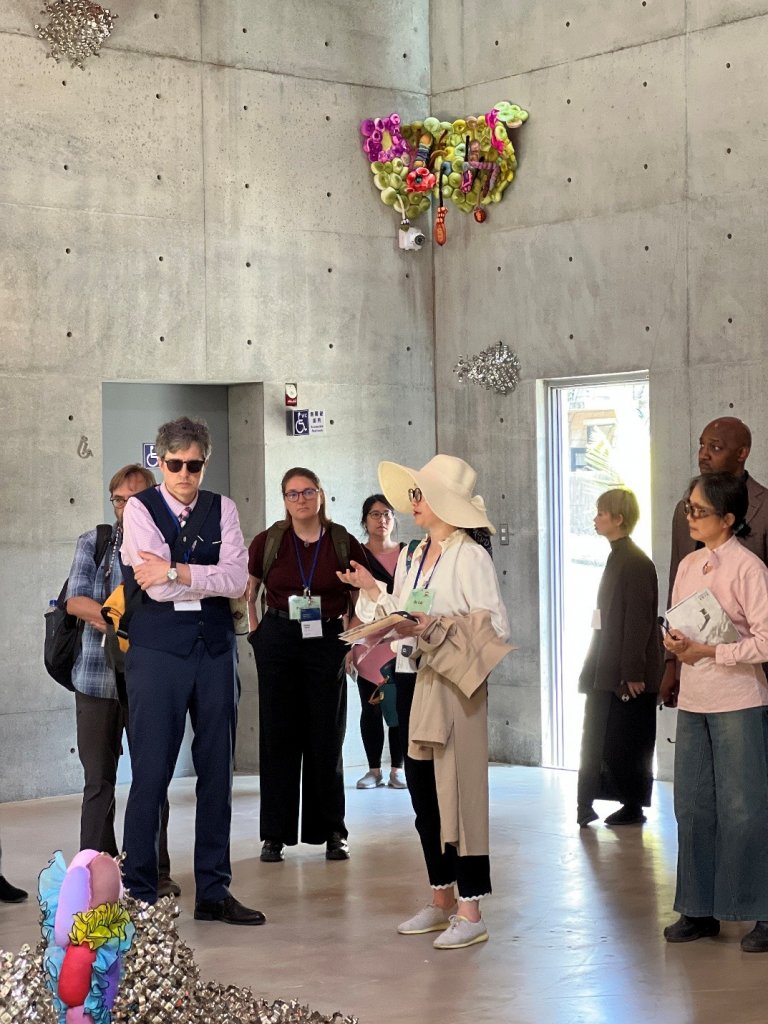
At the National Sun Yat-sen University in Kaohsiung, we learned an innovative learning community pedagogical project that combines the study of Philosophy, Theatre Art, Urban Development and Sustainability, using the case of a local community featured in Chung Li-ho’s fictions. This resonates very well with the interdisciplinary teaching communities we support at Bellevue College. At Tainan National University of the Arts, while going through their graduation art exhibit and ceramic studio, I’ve learned that they’ve previously hosted workshops featuring international teaching collaborations, such the Transcultural Cinema Production: Asia Documentary Co-Production Network Project. How about launching an international, interdisciplinary teaching workshop between Bellevue College and the universities in Taiwan?
As an educator researching how extended reality (XR) and immersive technologies can foster cross-cultural empathy, my time in Taiwan opened entirely new frontiers for my work. While I have long studied how bodily perspective-taking in virtual environments can bridge cultural gaps, walking through the rich, layered environments in Taipei, Tainan and Kaohsiung, posing for a picture in front of the old city gate in Tainan, buying a red-heart guava from a fruit vendor in Shi-men Ting, inspired concrete applications for my next XR-enhanced teaching module on culture and communication. How about applying for a grant in support of an interdisciplinary development of field-based XR learning modules in Seattle and Taipei? By capturing the spatial and cultural dimensions of those environments, I hope to create immersive, cross-cultural experiences that allow Bellevue College students, particularly those facing barriers to traditional study abroad, to engage in meaningful intercultural communication.
We’ve visited many universities in Taipei, Taichung and Kaohsiung, but the Fulbright IEA seminar provides opportunities to meet with many more beyond them. On the last day of the seminar, while discussing the sustainable tourism program with a professor from the National Dong Hwa University, I realized that while we had a busy schedule visiting many cities and universities, we really only explored a small slice; on the east coast, in Hualien and many other cities, the possibilities are boundless. Such networking opportunities are especially precious for faculty members like me, who are teaching at a community college and with limited resources or connections. The IEA seminar pushed me to think bigger and bolder about community college access to a more internationalized curriculum, for both faculty and their students.
For many years, Taiwan has remained to me as a twin sister who I’ve always heard about but never had the chance to meet in person. I read about Taiwan, its street food, people and lush green landscape through essays, novels and poetry done by my favorite writers. I watched Taipei city urban traffic in the cinematography created by my favorite film directors. Taiwan has been my memory that’s never actually lived, a cultural tie that’s never actually connected, in person, until now.