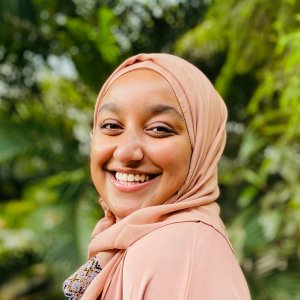
When people ask me about my Fulbright experience in Taiwan, they often expect me to talk about my academic achievements, research milestones, or professional growth. While those aspects have undoubtedly been important, they are not the first things that come to mind. Instead, I think about the people I met, the unexpected acts of kindness I experienced, and the countless moments that transformed Taiwan from a place where I was studying into a place that felt like home.
In many ways, my Fulbright journey began before I had even unpacked my suitcase. On my very first day in Taiwan, another Fulbright grantee and I decided to visit a coffee shop near Ximen. We were still adjusting to our new surroundings, processing the excitement and uncertainty that comes with moving halfway across the world. As we sat chatting over coffee, a local Taiwanese person struck up a conversation with us. Before long, they invited us to join an art class being held on the second floor of the building.
Neither of us expected our afternoon to take such a turn. The class was conducted entirely in Mandarin, a language I knew virtually nothing about at the time. Yet despite the language barrier, everyone welcomed us warmly. We quickly discovered that the artwork we created would eventually be displayed publicly at a bus stop in Taipei. Less than 24 hours after arriving in Taiwan, I had already made new friends and become part of a community project that connected local residents and international visitors.
Looking back, that experience foreshadowed so much of what would define my next two years. Taiwan consistently surprised me with its openness. Time and time again, strangers became friends, invitations turned into meaningful experiences, and moments of uncertainty transformed into opportunities for connection.
A few days later, I moved from the hotel Fulbright had set up for incoming grantees to my university dormitory. Like many international students, I needed to purchase basic necessities to make my new room feel livable, which meant a trip to IKEA. Although that sounds simple enough, it felt daunting at the time. I had never navigated Taiwan’s transportation system on my own. My Mandarin skills were practically nonexistent, and I had only a vague idea of where I was going. Standing at a bus stop, feeling somewhat overwhelmed, I decided to ask a Taiwanese student sitting nearby for directions. I expected him to point me toward the correct bus or explain which station I needed to transfer at. Instead, he accompanied me all the way to IKEA. The journey took nearly an hour.
Even now, two years later, I am still amazed when I think about it. He had no obligation to help me. He could have simply answered my question and continued on with his day. Yet he chose to spend his time ensuring that a complete stranger arrived safely at her destination.
That experience taught me something important about Taiwan. Kindness here often goes beyond convenience. People do not merely help when it is easy; they frequently go out of their way to make others feel welcome.
Throughout my time in Taiwan, I encountered countless examples of this generosity. One of my favorite memories occurred at a night market in Taipei. I was spending the evening with two international friends I had recently met. We had purchased various foods and were sitting together, enjoying our meal and chatting about our lives. Out of nowhere, a Taiwanese woman approached our table. She asked us a simple question: would we like to join her birthday celebration? At first, we thought she was joking. She was not.
Within minutes, we found ourselves sitting in a nearby restaurant celebrating the birthday of someone we had never met before. The next hour was filled with laughter, cake, conversation, and cultural exchange. The guests were fascinated by the fact that our small group represented several different countries and backgrounds. We shared stories about our lives, while they shared stories about theirs. What struck me most was how natural the interaction felt. A chance encounter at a night market became a memorable evening because someone decided to extend an invitation to strangers.
That experience captures what I believe is one of the most beautiful aspects of international exchange. Although Fulbright is often associated with academic and professional pursuits, some of the most meaningful exchanges happen in everyday moments. They happen over shared meals, spontaneous conversations, and unexpected invitations. They happen when people are curious enough to learn about one another’s lives. These moments remind us that despite differences in nationality, language, and culture, we share far more similarities than we often realize.
Another experience that profoundly impacted me took place during a trip to Xiaoliuqiu, a small island off the coast of Kaohsiung. Several friends and I traveled there during a break from our studies. As soon as we checked into our hotel, the staff offered us prayer mats for the duration of our stay. My friends and I all wear hijabs, making it immediately apparent that we are Muslim. I was genuinely surprised. Not only had the staff recognized our religious needs, but they had already prepared accommodations to ensure we felt comfortable during our visit.
This was the first time I had experienced something like this in a country where Muslims are a minority. What impressed me was not simply the availability of the prayer mats, but the thoughtfulness behind the gesture. It demonstrated a level of awareness and consideration that I had not expected to find on a small island. By the end of our stay, I asked the receptionist where she had purchased the prayer mats because I loved the waterproof material and wanted one for myself. To my surprise, she told me to keep it. What may have seemed like a small gesture carried significant meaning for me. It was yet another example of the kindness that I encountered throughout Taiwan and another reminder that this place had become much more than a temporary residence.
Taiwan increasingly felt like a second home. Beyond these chance encounters, I was fortunate to build lasting communities during my time in Taiwan. As a Muslim, one of the places that became especially important to me was the Taipei Grand Mosque. Attending Friday prayers allowed me to connect with Muslims from diverse backgrounds, including both local Taiwanese Muslims and international residents from around the world.
These relationships enriched my Fulbright experience in ways I could never have anticipated. One example is a friend I made who is half Taiwanese and lives in Hsinchu. When she graduated, she invited me and few others to celebrate with her family. We spent the day in her home, sharing stories, and enjoying a meal that blended Taiwanese and Jordanian cuisine.
Experiences like this allowed me to move beyond being a visitor and become part of people’s everyday lives. They provided opportunities to learn about Taiwan not through textbooks or tourist attractions, but through family traditions, shared meals, and personal relationships.
Some of my most cherished memories are connected to Ramadan. During both years of my Fulbright grant, the Taipei Grand Mosque hosted nightly iftars during the holy month. Each evening, people gathered to break their fast together. Students, professionals, families, and visitors from countless countries sat side by side sharing food and conversation. There is something uniquely powerful about communal worship and communal meals. Regardless of where people came from, everyone gathered around a shared purpose.
Many of my closest friendships in Taiwan began at those iftars. The sense of belonging I felt during Ramadan was particularly meaningful because it reminded me of home. Being far away from family during important religious occasions can sometimes feel isolating. Yet Taiwan provided a community that made those moments feel joyful rather than lonely.
The same was true during Eid celebrations. I will never forget arriving at Taipei Grand Mosque for Eid prayer and seeing the enormous crowd gathered outside. The mosque was so full that people laid prayer mats across surrounding areas and prayed outdoors. The sight instantly reminded me of celebrating Eid as a child with my family. For a moment, I felt transported back home despite being thousands of miles away. It was a powerful reminder that community transcends geography.
Perhaps one of the most fitting experiences to conclude my Fulbright journey occurred recently when a few fellow Fulbrighters and I climbed Yushan, Taiwan’s highest mountain. The climb was far more difficult than I anticipated. While I expected the physical challenge, I underestimated the mental challenge. The second day brought rain, strong winds, and cold temperatures. There were moments when I questioned whether I could continue.
What helped me persevere was not simply determination, but encouragement from those around me. As hikers passed each other along the trail, one phrase echoed repeatedly through the mountains: 加油. Over and over, strangers offered words of encouragement. My fellow Fulbrighters did the same. We motivated one another through difficult sections of the climb, shared laughs despite the challenging conditions, and celebrated each milestone together. By the time we reached the summit, I was exhausted. I had also somehow managed to lose three toenails in the process – a detail that still makes me laugh. Yet standing at the top of Yushan, I felt an overwhelming sense of accomplishment and gratitude.
The mountain became a metaphor for my Fulbright experience. The journey was not always easy. There were challenges, language barriers, moments of uncertainty, and periods of adjustment. But there were also people who offered encouragement along the way. There were communities that welcomed me, friendships that sustained me, and experiences that helped me grow.
When I first arrived in Taiwan, I expected to gain academic knowledge and professional experience. I certainly achieved those goals. However, what I did not anticipate was how deeply connected I would feel to this place and its people.
The greatest lesson Taiwan taught me is that belonging often begins with simple acts of kindness. A stranger inviting two foreigners to an art class. A student accompanying someone to IKEA. A birthday invitation at a night market. A hotel providing prayer mats. A community gathering for iftar. Fellow hikers offering encouragement on a mountain trail.
Individually, these moments may seem small. Together, they transformed my experience.
As my Fulbright journey comes to an end, I leave Taiwan with far more than memories. I leave with lifelong friendships, a deeper appreciation for cultural exchange, and profound gratitude for the generosity I encountered throughout these two years. Taiwan welcomed me as a visitor, but it leaves me feeling like family.
For that, I will always be grateful.
And while my Fulbright grant may be ending, I know this is not goodbye. Taiwan has become a place I will continue to return to, not only because of its beauty or opportunities, but because it has become a home away from home.